You can drink the cleanest water, eat the most nutrient dense food, and move your body every single day, and still feel like something is off when you’re sleep-deprived. The cravings will keep showing up. The patience will keep running out. The brain fog will keep winning.
We’ve come to accept that sleep deprivation is part of life. Most of us consume supplements to compensate for it to stay in the “healthy lane”. Sadly, no supplement, treatment or exercise can replace the repair that only the body can do for itself.
Listen to this podcast now at C3 Podcast or join us on Apple Podcasts or Spotify.
Why Sleep Is a Foundation of Overall Health
Sleep is not a passive state where the body shuts down. It is one of the most active repair processes the body runs. During sleep:
- The brain processes and consolidates information
- Hormones recalibrate
- The nervous system resets
- Muscles recover from the day’s demands
- The immune system carries out critical repair work
When sleep is cut short or fragmented, those processes do not complete the way they are supposed to. The body does not just feel tired. It falls behind on every system that keeps you functioning, recovering, and thinking clearly.
How Sleep Impacts Appetite, Mood, and Focus
After even one night of poor sleep, the hunger hormone ghrelin increases while leptin, the hormone that signals fullness, decreases. This is why sleep deprived people crave sugar, fat, and quick energy. It is compensating for the lack of energy.
On top of that, insulin sensitivity drops, making blood sugar harder to regulate and creating those midday crashes and afternoon cravings that feel impossible to control. A study found that even partial sleep deprivation over just a few nights significantly reduced insulin sensitivity in healthy adults.
Mood takes a hit just as fast:
- Cortisol levels rise, leaving you more reactive and less resilient
- Small inconveniences feel bigger
- Patience shrinks
- Emotional regulation weakens
And then there is focus. Memory gets worse, mental clarity drops, and the brain starts prioritizing immediate comfort over long term goals. You skip the workout. Reach for the convenient food, procrastinate, then feel mentally checked out.
That is not laziness. That is a sleep deprived brain doing what sleep deprived brains do.
Tips on How to Retrain Your Circadian Rhythm Back to Healthy Sleeping
It can be frustrating to adjust to sleep if you’ve been sleep-deprived for a long time. Yet, it’s not impossible to get back to health. Start with the basics:
- Make your room truly dark: Even small amounts of light can interfere with melatonin production. Street light leakage, LED indicators, a phone lighting up, all of it sends mixed signals to your brain.
- Keep the room cool, ideally around 65 degrees: Your body temperature naturally drops as it prepares for sleep. A cooler room supports that process rather than fighting against it.
- Cut off screens at least one hour before bed: The American Academy of Sleep Medicine recommends avoiding blue light from handheld electronics for 30 to 60 minutes before bedtime to support the body’s natural wind down signals.
- Stop eating about three hours before bed: This gives digestion time to settle so your body is not doing two demanding jobs at the same time.
CODE Health Believes in the Power of the Body’s Healing Through Sleep
CODE Health has always positioned sleep as one of the most foundational pillars of health, not as an afterthought, but as a non-negotiable.
For those who need support winding down and staying asleep without the side effects of over the counter sleep aids, CODE’s DREAM and CALM formula work together as the Healthy Mind Duo.
- CALM supports the nervous system during the day so the body is not carrying unresolved stress into the night.
- DREAM guides the body gently into deeper, more restorative sleep.
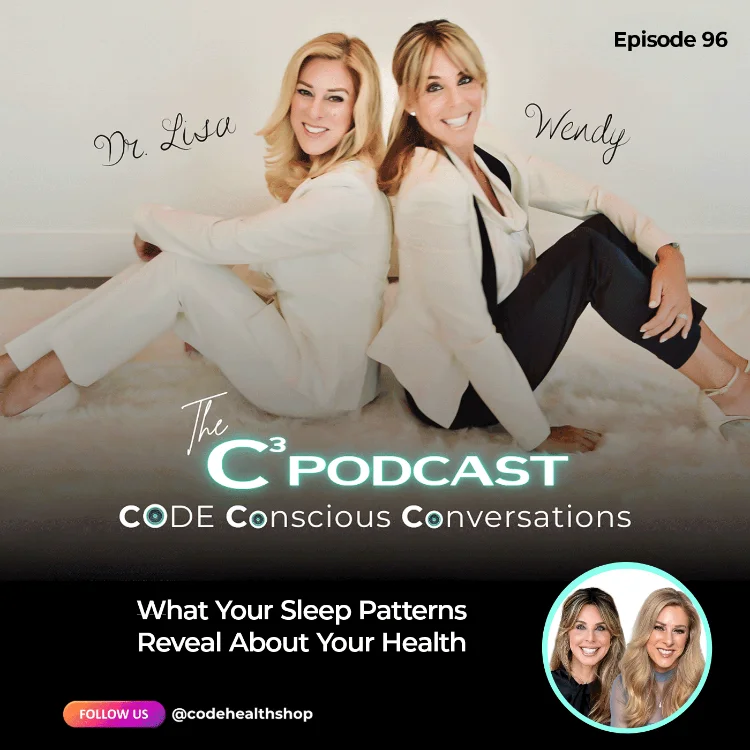
We dive deeper into this in our latest episode in C3 Podcast about sleep health.
We also cover:
✅ The two hormones that flip after just one bad night of sleep.
✅ Why your brain chooses comfort over long-term goals when you are sleep deprived.
✅ The simplest bedroom change most people overlook.
What Your Sleep Patterns Reveal About Your Health
Listen to this podcast now at C3 Podcast or join us on Apple Podcasts or Spotify.