You wake up tired even after spending enough hours in bed. Focus fades earlier than it used to. Digestion feels unpredictable. Stress lingers long after the moment has passed.
This pattern isn’t driven by a lack of discipline or resilience. It’s shaped by a nervous system that rarely receives a clear signal to stand down, continuously responding to stimulation it was never designed to process without pause. Over time, that state becomes familiar. Alertness turns into a baseline.
The result is subtle but far-reaching. Energy feels inconsistent. Recovery takes longer. Rest stops feeling restorative. What looks like burnout is often regulation that never fully completes.
Listen to this podcast now at C3 Podcast or join us on Apple Podcasts or Spotify.
When Stress Stops Being an Event
The nervous system evolved to handle intensity in short windows. A challenge appears, the body mobilizes, and once the moment resolves, physiology shifts back toward repair.
Modern environments disrupt that rhythm. Notifications, artificial lighting, digital engagement, wireless signals, and time pressure remove the natural distinction between action and recovery. Instead of cycles, the nervous system experiences continuity.
When stimulation becomes constant, the body adapts by staying partially activated. That adaptation keeps systems online, but it quietly deprioritizes processes that rely on safety signals, including digestion, immune coordination, and cellular repair.
Why the Body Responds to Environment First
Physiology does not respond to intention alone. It responds to information.
Light exposure, sensory load, electromagnetic input, breath patterns, and timing all feed into how the nervous system assesses safety. When those signals suggest urgency or demand, the body stays prepared. When they suggest stability, regulation becomes possible.
This helps explain why healthy habits sometimes fail to create the expected results. If the signal environment remains unchanged, biological patterns follow the same script.
Why Sleep Doesn’t Always Restore
Sleep is designed to complete the regulatory loop. During deep stages, brain activity slows, inflammatory processes settle, and tissue repair accelerates.
Those stages are especially sensitive to environmental inputs. Light exposure, late cognitive stimulation, and wireless signaling can fragment slow-wave activity without shortening total sleep time. The body remains half-alert through the night, even when the clock suggests rest.
Waking up tired after a full night isn’t a mystery. It reflects a nervous system that never fully disengaged.
Breath as a Biological Signal
Breathing functions as more than oxygen exchange. It acts as a continuous signal to the nervous system.
The way air moves through the body influences vagal tone and how the brain reads safety. Slowing the exhale before eating or before engagement shifts that signal. Those shifts affect digestion, inflammatory response, and how efficiently the nervous system releases stress once demand passes.
This isn’t about calming the mind. It’s about delivering cues the body actually understands.
Low-Intensity Inputs and Daily Regulation
Regulation does not improve through force. It improves through consistency.
Low-intensity inputs like gentle warmth, rhythmic signals, grounding sensations, and reduced stimulation create familiarity for the nervous system. Over time, those inputs reintroduce safety cues that modern environments often lack.
Rather than overriding the system, they allow it to self-correct.
Why Recovery Feels Harder Than It Used To
Bodies haven’t become weaker. Signal environments have become louder.
The nervous system now processes more information than it evolved for, with fewer natural shutdown cues built into daily life. Without intentional transitions, activation becomes default.
Understanding this reframes fatigue, poor sleep, and low resilience as adaptive responses, not personal failures.
Bringing It All Together
Nervous system regulation breaks down when stimulation becomes constant and recovery becomes optional. The body stays alert not because it’s malfunctioning, but because its environment keeps asking it to be ready.
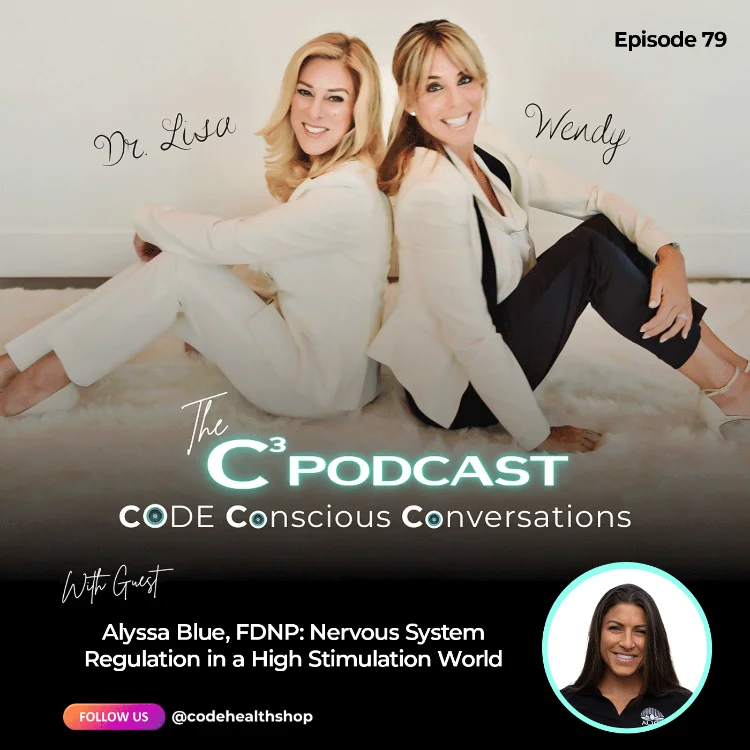
In Episode 79 of C3 Podcast: CODE Conscious Conversations, these ideas are explored in depth with Alyssa Blue, FDNP, a former aerospace engineer turned functional diagnostic nutrition practitioner. The conversation examines how modern inputs shape nervous system behavior, why sleep often fails to repair fully, and how small shifts in environment and physiology support long-term regulation.
Episode 79:
Alyssa Blue, FDNP: Nervous System Regulation in a High Stimulation World
🎧 Listen now on Apple Podcasts or Spotify.
FAQs: Nervous System Regulation and Chronic Stimulation
Why does the body stay in high alert even when stress has passed?
Because the nervous system responds to ongoing signals from the environment. When stimulation remains constant, the system never receives a clear cue to disengage.
Is chronic nervous system activation psychological or physiological?
It’s physiological. Alertness is driven by sensory input, light exposure, breath patterns, and environmental signals, not mindset alone.
Why doesn’t sleep always feel restorative anymore?
Deep sleep depends on slow brainwave activity that is highly sensitive to stimulation. Light, wireless input, and mental engagement close to bedtime can fragment recovery even when sleep duration looks adequate.
How does stress affect digestion and hormones?
Under prolonged alertness, blood flow and energy prioritize vigilance over digestion, detoxification, and repair. Over time, this contributes to gut issues and hormonal disruption.
Why does breathing influence nervous system regulation?
Breath patterns influence vagal tone and how the brain reads safety. Slowing the exhale provides a signal that supports digestion, reduces inflammatory load, and helps the system disengage after stress.
Do small environmental changes actually matter?
Yes. Small, consistent shifts compound over time. Regulation improves when signals shift repeatedly toward safety rather than intensity.
Is nervous system regulation about doing more?
Often it’s about reducing interference. When stimulation lowers, the body naturally reallocates resources toward repair.
Listen to this podcast now at C3 Podcast or join us on Apple Podcasts or Spotify.