Most of us learned what “healthy” means before we ever learned what our own body needs. We read the labels. We buy the “organic” products. We avoid the processed ones.
And still, somewhere underneath, something isn’t quite working. What if the problem isn’t that you’ve been eating poorly, but that the word “healthy” has been misaligned to what is truly healthy for you?
Listen to this podcast now at C3 Podcast or join us on Apple Podcasts or Spotify.
Why You Should Treat Food As Information
The same ingredient can nourish one body and inflame another. That is the gap and the measurable biology we all miss.
Research in nutrigenomics shows that genetic variations determine how each person metabolizes foods, processes nutrients, and responds to specific compounds. One of the most common of these variations is a mutation called MTHFR, which affects how the body processes folate and clears toxins.
What nourishes a body without that mutation can accumulate in a body that carries it. That is not an edge case. An estimated 30%-40% of the population carries some form of it.
Lindsay “Loo” O’Neill-O’Keefe has seen this pattern in her own life. She was eating what the wellness industry called clean, and her body, carrying MTHFR mutations, could not process any of it efficiently. The foods marketed as her allies were quietly working against her.
Where Healthy Gets Lost In Translation
Lindsay’s work as a Harvard-certified Culinary Medicine Chef and her two decades in AI and machine learning gave her something most people don’t bring to a chronic illness diagnosis. She had a framework for treating her own body like a dataset.
When she was diagnosed with rhupus, a dual autoimmune condition where rheumatoid arthritis and lupus overlap, she started testing everything she ate. What she found was that foods almost every nutritionist calls healthy were silently inflaming her body:
- Bananas
- Broccoli
- Pineapples
- Avocados
- Coffee
It’s not because these foods were bad but because her biology could not process them.
The Key Signal In Nutrition That People Keep Missing
Chronic inflammation rarely announces itself. It tends to show up as symptoms that most people treat separately, without realizing they are often coming from the same source.
The most common signals include:
- Weight gain and stubborn bloating
- Brain fog and difficulty concentrating
- Anxiety and mood fluctuations
- Insomnia or disrupted sleep
- Fluctuating hormones
- Persistent fatigue
Lindsay argues these are often all coming from the same root. The body is trying to reject food it cannot process while the person keeps eating it.
The same applies to supplements, even the natural ones. If your genetics cannot process the ingredients, the supplement intended to help you ends up hurting you.
In Lindsay’s words: everything you put in your mouth is either inflaming you or nourishing you. There is no third option.
Practical Tips To Find Out What Healthy Foods Work For You
The entry point does not require a protocol. It requires a shift in the question you’re asking.
Instead of asking, “Is this food healthy?” start asking, “Is this food healthy for my body?” The shift is subtle, but it changes what you pay attention to. You stop listening to the label. You start listening to the response.
Here are three small hinges you can apply this week:
- Run the three-day test. Remove a single food you suspect isn’t working for you, wait three to five days, and notice what changes in your energy, digestion, or clarity.
- Track the aftermath, not just the meal. Keep a simple log of how you feel two to four hours after eating. That is the window where inflammation tends to show itself.
- Consider a food inflammation test. You may try the Small Hinges Inflammation Test to know if you don’t clear a reaction because it’s either too strong of a reaction or you’re re-reactivating yourself constantly and your body sends in this C3d protein to the site of that reaction.
Lindsay calls this the Small Hinges philosophy. You do not have to change everything. You change one thing your body is clearly asking you to change, and you let the result teach you the next shift.
How CODE Health Supports The Shift To Individualized Health
CODE Health has always believed the body has an extraordinary capacity to restore itself when given the right information. That is exactly what brought Lindsay “Loo” O’Neill-O’Keefe into the CODE Conscious Conversations family.
In our latest episode, Lindsay goes deeper into how the wellness industry confuses universal answers for personal ones, and what you can do today to start listening to what your body is actually saying.
✅ Why even “healthy” foods can silently inflame the wrong body.
✅ How a skeptic built her own verification system after her daughter’s asthma emergency.
✅ The Small Hinges philosophy that changed Lindsay’s entire healing approach.
Learn More About Lindsay “Loo” O’Neill – O’Keefe:
Website: https://lindsayloo.com/
Instagram: @lindzoneill
Book: Biohacking Breakfast
TEDxBayonne: The Data-Driven Journey to Optimal Health
Gaia Talk: Inflammation Reduction Strategies
AI Platform: https://www.biohackingcompanies.com/
Podcast: Optimize W(e)
Learn More About Wellness Eternal:
- Website: https://wellnesseternal.com/home
- Instagram: @wellnesseternal_
- Facebook: Wellness Eternal
- YouTube: @WellnessEternal
Learn More About Small Hinges:
- Website: https://www.smallhinges.health/
- Instagram: @smallhinges
- Facebook: Small Hinges
- YouTube: @smallhinges
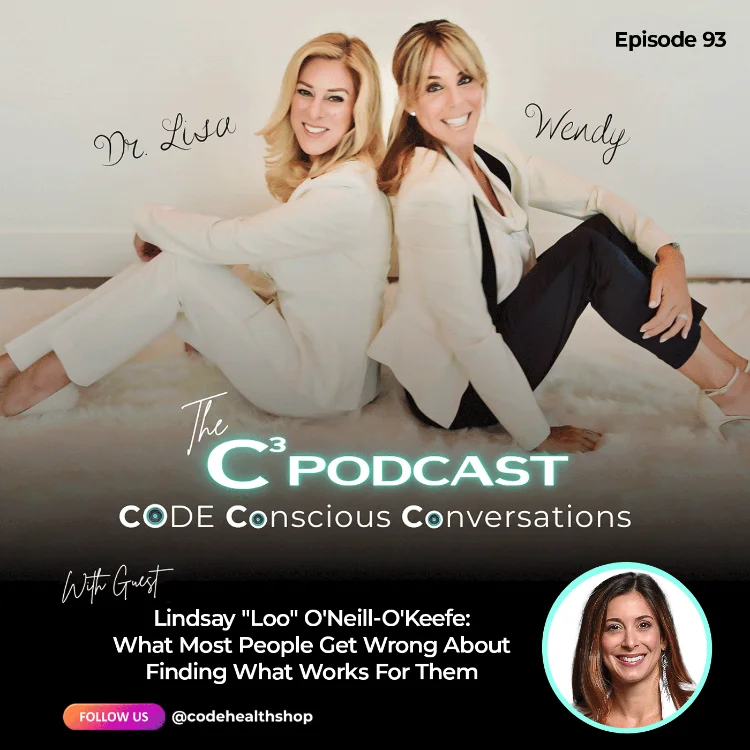
Lindsay “Loo” O’Neill-O’Keefe: What Most People Get Wrong About Finding What Works For Them
Listen to this podcast now at C3 Podcast or join us on Apple Podcasts or Spotify.