Your metabolism listens long before it reacts, and it responds to information far earlier than it responds to chemistry. Although most people believe that food addiction is a matter of discipline, calorie control, or willpower, what actually drives the pattern is the invisible communication running between the gut, the brain, and the emotional imprints formed in childhood. When the messages circulating in this system become chaotic, the body follows with cravings that feel bigger than logic, reactions that feel stronger than choice, and coping mechanisms that operate beneath conscious control. This is where lasting change becomes possible, because when you shift the information running through the system, you shift the system itself.
Healing begins to unfold the moment the internal dialogue changes, especially when it comes from a place of relational safety. This is why the mother–daughter dynamic is one of the most powerful laboratories for metabolic rewiring. When two people who have shaped each other for decades begin to shift patterns together, their nervous systems reorganize in ways that are profound, stabilizing, and biologically meaningful. Episode 74 brings this truth to the surface in a way that feels both intimate and deeply instructive, because it examines the patterns that shape us long before we ever choose food.
Listen to this podcast now at C3 Podcast or join us on Apple Podcasts or Spotify.
The Most Common Question We Hear
Even among high performers, the question that returns again and again is simple: Why do I know exactly what to eat, what to avoid, and how I want to feel, yet I still return to the same food loops when stress hits? The answer rarely lives in knowledge or nutrition. It lives in the subtle forms of attachment, emotional inheritance, and learned self-regulation that form the backbone of our biology. Food choices are often the visible expression of something internal that has not yet been named, and this is why information alone is never enough. To change your biology, you must change the patterns that shape how your biology perceives itself.
This is the lens through which Helene Leeds and Penelope Popken have built their work, and in this episode they reveal how the healing of one body can ignite the healing of another, especially when the relationship between those bodies carries decades of shared history. Their perspective is not built on restriction or guilt, but on relational repair, metabolic intelligence, emotional literacy, and nutritional clarity. Together they map the path that allowed them to transform their relationship with food and with each other, creating a model that helps families interrupt the generational loop of addiction, shame, and coping.
A Deeper Kind of Food Freedom
In this episode of the C3 Podcast, we sit down with Helene Leeds, health educator and founder of sustainable metabolic transformation programs, and Penelope Popken, researcher and practitioner in food addiction recovery, to unpack the emotional, neurological, and relational roots of food dependency. We explore how patterns begin long before the first craving appears, how stress physiology shapes the way the brain seeks comfort, how the nervous system interprets food as emotional safety, and how mother–daughter dynamics can either reinforce or dissolve these loops. Because food addiction is not a failure of discipline, but a communication error inside the body’s predictive systems, we map how realignment becomes possible through attachment repair, emotional sequencing, metabolic stabilization, and identity-level reframing.
The conversation unfolds through the very real story of Helene and Penelope’s own journey, offering insight into how children absorb the emotional state of their parents, how mothers unconsciously transmit food patterns through their relationship with nourishment, and how healing this bond can create changes that ripple across physiology, family culture, and self-perception. Their work reframes food addiction as a relational wound that often masquerades as a nutritional problem, and because this reframing shifts the entire approach to healing, it becomes a turning point for anyone who has attempted to change habits without addressing the underlying emotional architecture.
The Mother–Daughter Blueprint for Repatterning Behavior
We also explore how the mother–daughter relationship holds a unique capacity to reorganize attachment pathways that influence eating patterns, chronic stress responses, and self-regulation. Helene and Penelope describe how their own healing process required them to step out of familiar identities, confront emotional inheritance, challenge long-held narratives around body, worth, and nourishment, and replace old cues with forms of emotional presence that recalibrated their nervous systems. This process created not only behavioral change but perceptual change, which ultimately shifted their biology.
As they explain, food addiction tends to dissolve when the internal system no longer perceives threat, loneliness, or emotional scarcity. When communication between the gut, brain, and emotional centers becomes coherent, cravings change, choices change, energy stabilizes, and the entire metabolic landscape becomes more responsive. Their story demonstrates how safety creates the conditions for metabolic transformation, and how relational healing can become the most powerful nutritional intervention available.
Why Families Carry Food Patterns Across Generations
One of the most impactful insights from this episode is the recognition that food patterns usually begin as emotional adaptations. Children learn to self-soothe, self-regulate, and self-protect by watching their caregivers, and these early strategies later show up as compulsive eating, chaotic dieting, perfectionism, or resistance to nourishment. Helene and Penelope walk us through how these patterns formed in their own family line, how they disrupted them through emotional attunement and nutritional clarity, and how this model can be applied to any parent–child relationship seeking to break cycles of addiction and shame.
Their work illustrates how food becomes a language that families speak long before anyone understands its meaning. When this language is decoded with compassion rather than correction, individuals discover that they never lacked willpower; they lacked safety, coherence, and emotional capacity. The transformation that follows is not superficial but structural, influencing how the body handles stress, how the brain processes emotion, how the nervous system returns to baseline, and how identity reorganizes around a more grounded sense of self.
The Role of Emotional Sequencing in Metabolic Change
Throughout the conversation, we explore the concept of emotional sequencing, which describes how unprocessed emotions create physiological patterns that manifest as cravings, compulsions, or metabolic resistance. Helene and Penelope explain how emotional congestion alters dopamine regulation, cortisol rhythms, hunger cues, and reward pathways, and why naming emotions in real time can reestablish clarity across these systems. This process teaches the body that it no longer needs to use food to create safety, and when this happens, metabolic change accelerates because the system is no longer working against itself.
They also describe how emotional repair and nutritional repair must occur simultaneously, because the body cannot sustain behavioral change if the emotional architecture remains unchanged. When individuals learn to recognize the early signs of emotional escalation, intervene before biology takes over, and redirect the cycle through clarity and connection, the system becomes responsive, intelligent, and capable of sustaining transformation without relapse.
Food Addiction as a Signal, Not a Failure
Another central theme of the episode is the idea that food addiction is not a personal flaw but a biological signal. The body communicates through discomfort when something is out of alignment, and cravings often represent an attempt to stabilize a system that feels overwhelmed. Helene and Penelope guide us through how to interpret these signals, how to separate genuine physical needs from emotional surges, and how to reframe cravings as information rather than moral judgment. This shift dissolves shame, which is one of the biggest drivers of relapse.
Their perspective also reframes relapse itself as data rather than defeat. When individuals learn to read their body’s messages instead of reacting to them, patterns that once felt compulsive become opportunities for recalibration. This approach creates a form of emotional agency that fundamentally changes how individuals relate to food, stress, and themselves.
The Nutritional Strategy That Supports Nervous System Repair
Alongside the emotional landscape, the episode dives deeply into the nutritional principles that supported Helene and Penelope’s transformation. Their approach focuses on stabilizing blood sugar, reducing inflammatory load, supporting gut integrity, and increasing nutrient density, all while maintaining enough flexibility to avoid diet culture rigidity. They outline how these nutritional choices strengthen the nervous system, reduce emotional volatility, support clearer decision-making, and create the internal stability required for behavioral change to last.
This nutritional architecture empowers the body to function from coherence rather than survival, which is essential for untangling addiction patterns. The combination of emotional integration and biological stabilization creates a feedback loop that accelerates healing and reinforces identity-level change.
How Identity Shapes Food Behavior
One of the most striking insights from Helene and Penelope is that no amount of nutritional education can override an identity rooted in stress, scarcity, or emotional fragmentation. They explain how identity is formed through early relational experiences, how food becomes part of that identity, and how individuals can consciously reconstruct the narratives that shape their relationship with nourishment. This process transforms not only eating patterns but self-perception, confidence, agency, and the ability to maintain change long term.
Identity-level transformation becomes the anchor for behavioral transformation, because when individuals begin to see themselves as calm, stable, capable, and worthy, their biology organizes around behaviors that reflect that identity. This shift becomes the foundation of sustainable food freedom.
FAQ: 10 Essential Questions About Food Addiction and Mother–Daughter Healing
1. What actually causes food addiction at the biological level?
Food addiction arises from a combination of dopamine dysregulation, stress-related cortisol spikes, gut–brain signaling imbalances, and emotional conditioning that teaches the body to use food as safety rather than nourishment. These biological and emotional patterns combine to form loops that feel compulsive.
2. Why is the mother–daughter relationship so central in healing food patterns?
Because the mother is often the first source of regulation, nourishment, and emotional modeling, the daughter’s relationship with food is shaped by how safety, stress, and emotion were expressed within that bond. Repairing this relationship can reorganize the nervous system and dissolve patterns formed in childhood.
3. Is food addiction really about willpower?
No. It is about the body’s attempt to regulate emotional overload, stabilize stress physiology, or fill relational gaps. Willpower becomes irrelevant when the system feels unsafe, because biology will always override logic in the pursuit of stability.
4. How do emotional wounds show up as cravings?
Unprocessed emotions create internal tension that the body attempts to soothe. Because food delivers immediate biochemical and sensory relief, the brain interprets it as a reliable regulator, linking emotional distress with compulsive intake.
5. Can families really change generational food patterns?
Yes. When communication becomes clear, when emotional safety is restored, and when individuals learn to decode their internal signals, families can break patterns that have persisted for decades and create entirely new nutritional and emotional cultures.
6. What role does the nervous system play in food addiction?
The nervous system determines whether the body is in survival or stability. When the system is overwhelmed, eating becomes a coping mechanism. When the system is regulated, cravings diminish and behavior becomes intentional.
7. What nutritional strategies help stabilize addiction patterns?
Stabilizing blood sugar, prioritizing nutrient density, supporting gut integrity, and reducing inflammatory load create a biological environment where emotional clarity and behavioral change can occur more easily.
8. How does relational repair affect metabolism?
When individuals feel emotionally safe, cortisol decreases, digestion improves, hunger cues normalize, and the body no longer uses food as a compensatory mechanism. Relational safety becomes a metabolic intervention.
9. Why is identity work essential for lasting food freedom?
Because behavior follows identity. If an individual still sees themselves as chaotic, overwhelmed, or dependent on food for comfort, their biology will reinforce those patterns. Shifting identity recalibrates the entire system.
10. Can food addiction truly be reversed?
Yes, when emotional sequencing, nutritional stabilization, nervous system regulation, and relational healing converge. This creates a new internal architecture that dissolves compulsive patterns by making them biologically unnecessary.
Listen to the Full Episode
To explore the full conversation with Helene Leeds and Penelope Popken, including their personal journey, their framework for emotional and metabolic repair, and their mother–daughter approach to transforming food addiction, listen to:
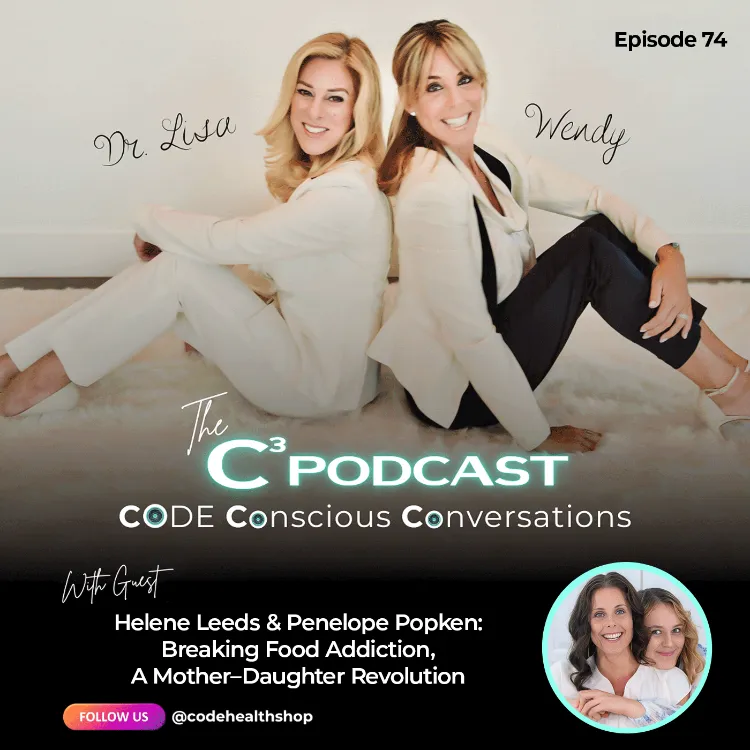
Episode 74. Helene Leeds & Penelope Popken: Breaking Food Addiction, A Mother–Daughter Revolution
Listen to this podcast now at C3 Podcast or join us on Apple Podcasts or Spotify.