General anesthesia does not put the brain to sleep. It interrupts consciousness and temporarily disrupts communication across critical brain networks.
That distinction matters. Especially when we begin examining cognitive decline after surgery, emotional shifts, and the long term resilience of the nervous system.
Listen to this podcast now at C3 Podcast or join us on Apple Podcasts or Spotify.
Anesthesia Is Not Sleep
Sleep restores the brain. It clears metabolic waste. It allows repair. It recalibrates neural circuits.
General anesthesia does not do that.
When someone is asleep naturally, their nervous system is still responsive. Pain can wake them. Sound can wake them. The brain is cycling through structured stages that support repair.
Under general anesthesia, awareness is shut down. Movement stops. Pain does not register. Communication pathways are blocked so that perception cannot form in the first place.
It is not deep sleep. It is interruption.
And that changes how we think about recovery.
What Happens to Consciousness Under General Anesthesia
The standard explanation is receptor based. Anesthetics stimulate GABA. Neural firing is suppressed. Consciousness fades.
But that explanation leaves gaps. Stimulating the same receptors with other substances does not produce full unconsciousness. So what else is happening?
Research discussed in the conversation points inward, into the neuron itself. Inside neurons are structures called microtubules. These structures vibrate at extremely high frequencies. According to the Orch OR theory developed by Dr. Stuart Hameroff and Sir Roger Penrose, those vibrations may generate quantum coherence linked to conscious awareness.
When general anesthetics are introduced, that high frequency coherence disappears. When the anesthetic is withdrawn, the frequency returns.
Hameroff’s research includes measurable frequency changes at the neuronal level. Microtubule stabilizing drugs such as tamoxifen have been shown to increase the amount of anesthetic required to induce unconsciousness. Similar findings have appeared in animal models.
The theory is still debated. But it moves the conversation beyond surface receptor activity and into structural coherence inside the brain.
Brain Fragmentation and Communication Breakdown
General anesthesia does not only suppress awareness. It disrupts integration.
Communication between the frontal lobe, limbic system, thalamus, and temporal regions becomes fragmented. For many patients, the brain reintegrates smoothly after surgery. For others, that fragmentation lingers.
This may help explain why some people experience mental health shifts, emotional instability, or cognitive changes after surgery, even when everything went “well.”
Clinically, anesthesiologists are cautious with elderly patients because cognitive decline after general anesthesia is observed in practice. Yet many meta analyses conclude there is no association. One reason may be that studies often fail to distinguish between regional anesthesia and full general anesthesia, which are not equivalent exposures.
The nuance matters.
Why Some People Need More Anesthesia
Response to anesthesia is not uniform.
Genetics play a role. Individuals with red hair, linked to specific genetic variants, often require significantly more anesthesia. Collagen disorders such as Ehlers Danlos and Marfan syndrome are also associated with increased resistance to anesthetics and pain medications.
These variations highlight something important. Dosing is not one size fits all.
More anesthesia may achieve unconsciousness. But it also increases chemical exposure and physiological stress.
Surgery as Physiological Stress
Anesthesia never happens alone. It accompanies surgery.
Surgery triggers immune activation. Inflammatory signaling increases. Mitochondria shift into stress response. Even if the patient is unconscious, the body is not passive.
Cells respond. The nervous system reacts. The immune system shifts along with it.
If neuro resilience is low going into surgery, vulnerabilities tend to surface during recovery. That is usually when people realize preparation mattered more than they thought.
Preparing the Brain Before Surgery
Preparation is rarely about a single supplement.
The foundational work is simple. Clean air. Clean water. Nutrient dense food. Sunlight exposure. Time outdoors. A dietary pattern that blends paleo principles with Mediterranean elements to support metabolic and neurological stability.
Lifestyle comes first.
Supplementation may play a role. But it does not replace foundation.
Resilience is built before exposure, not after damage has occurred.
Recovery After Anesthesia
Post operative recovery is often reduced to detoxification. That is only part of the picture.
Environment influences recovery more than most people expect. Chronic stress slows healing. Fear based media increases cortisol. Interpersonal stress drains energy. Music shifts physiological state.
Recovery includes reintegration of brain communication. It includes reducing inflammatory load. It includes creating an environment that supports nervous system recalibration.
Detox is not only biochemical. It is environmental. It is neurological.
Bringing It Together
General anesthesia may be temporary. But the physiological disruption it creates doesn’t always resolve the moment the drugs wear off.
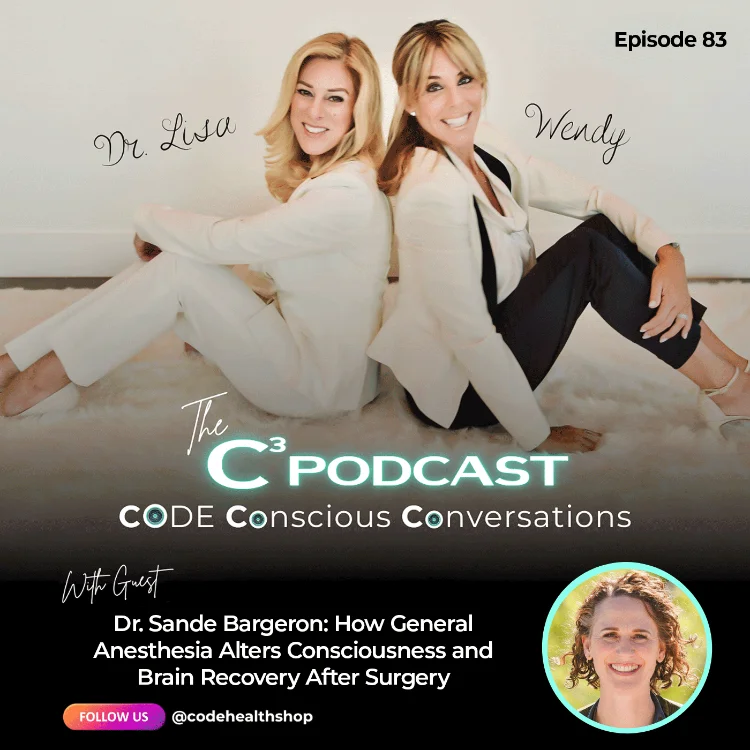
In the latest episode of C3 Podcast: CODE Conscious Conversations, Dr. Sande Bargeron shares her clinical experience as an anesthetist and her research into microtubules, quantum coherence, cognitive vulnerability, and resilience strategies before and after surgery.
We also explore what happens to consciousness under general anesthesia, how neural communication becomes fragmented, and why preparation and recovery are essential for long term brain health.
If you are preparing for surgery or supporting someone who is, this discussion provides a clear and clinically grounded perspective on anesthesia and brain recovery.
Learn More About Dr. Sande Bargeron, BCDNM, PA-C:
Website: https://beyondbrainhealth.com
Instagram: @beyondbrainhealth
Youtube: @sandebphd
TikTok: @drsande
Listen to this podcast now at C3 Podcast or join us on Apple Podcasts or Spotify.