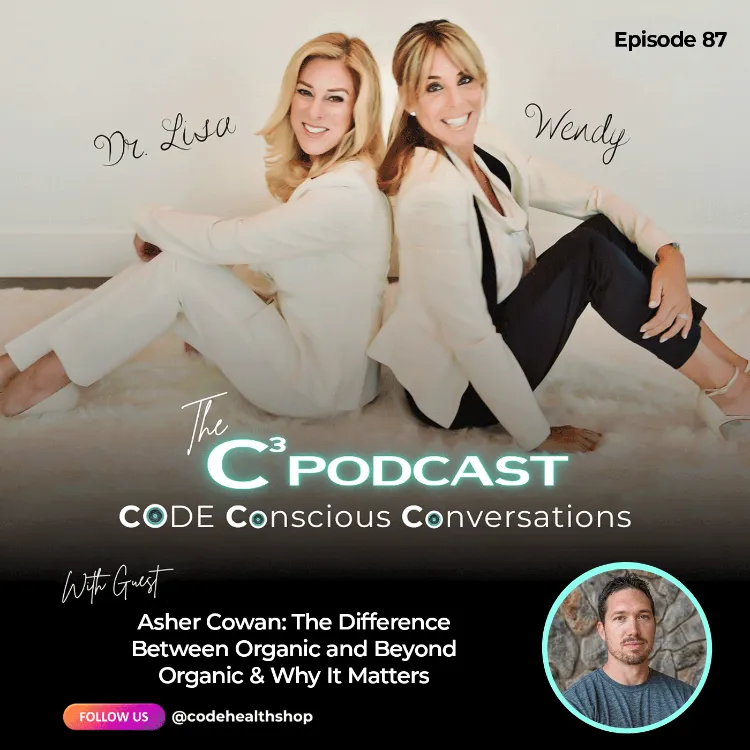
Featuring insights from Asher Cowan, Co-Founder & CEO of Dr. Cowan’s Garden
We are what we eat. And the conversations we often have around food and health tend to focus on what we eat. Less attention goes to what happens to food before it reaches us and how that determines whether the body can actually use it.
In our latest podcast Episode at Code Health, our guest, Asher Cowan, co-founder and CEO of Dr. Cowan’s Garden, frames it this way: the body is an electrical system. It runs on energy, and that energy comes from food.
When food has been processed, microwaved, or grown with heavy pesticide application, the vitality that was supposed to power the body’s daily repair work is no longer there.
The body may not break down immediately but it gradually loses the resources it needs to keep up with detoxification, tissue repair, and the management of everyday stressors.That framing shifts the question from “what should I eat?” to “what is still in the food by the time I eat it?“
Listen to this podcast now at C3 Podcast or join us on Apple Podcasts or Spotify.
The Science of Food Preparation That Impacts Nutrition
Preparation is where most of the nutritional conversation gets skipped over. The ingredient can be certified organic and still arrive biologically compromised depending on how it was handled.
In each case below, the processing step either preserves what is in the food or eliminates nutrient blockers.
- Soaking: Raw, unsoaked nuts and grains contain phytic acid, an anti-nutrient that binds to minerals in the digestive tract and blocks their absorption. Soaking breaks down the phytic acid, makes the nutrients bioavailable, and improves digestibility. The ingredient is the same but the preparation determines what the body actually receives from it.
- Sprouting: Grains that are sprouted before consumption have their enzyme inhibitors broken down further, making proteins and nutrients easier for the body to process. This is not a new grain practice; it reflects how grains were traditionally prepared before industrial processing standardized the shortcuts.
- Cold extraction: Olive oil that contacts heat during extraction undergoes structural changes to its fatty acids before it is bottled. Keeping the extraction process cold preserves the oil’s biological integrity from the point of pressing through to the shelf.
- Raw fermentation: Sauerkraut or any fermented food that is pasteurized loses the live bacteria that make fermented foods worth eating. Keeping fermentation raw and unpasteurized retains the microbial activity that supports gut health and nutrient absorption.
- Light blanching: Kale consumed raw contains oxalates that interfere with mineral absorption. Lightly blanching or steaming before dehydration reduces the oxalate load and makes the nutrition in the vegetable accessible rather than blocked.
What to Consider When Sourcing Organic Food
USDA organic certification used to be the only basis of organic. However, now it is just a starting point, not an endpoint when considering what real organic produce means. Asher Cowan notes that the standards have shifted over time, with allowances that have gradually made the label less reliable as a measure of true food quality.
Certification tells you something about how a crop was grown. It says nothing about the supply chain after it left the farm, or whether the processing preserved what made it worth sourcing in the first place.
Sourcing directly from farms rather than through large ingredient distributors is one way to close that gap. It keeps the chain of custody visible and gives the producer control over every stage from harvest to finished product.
Many of the farms that operate at this level are certified biodynamic, a standard that goes further than organic in its requirements for soil health, farming practices, and ecological balance.
For most consumers, the practical implication is that reading a label is enough. The front of the package may describe what the product and the ingredient list describes what is in it. However, neither tells you how the key ingredients were grown, where they came from, or what happened to them between the farm and the shelf.
To guide you in gauging beyond organic products, here are a useful set of questions:
- Where was this ingredient sourced?
- Was it processed with heat?
- Was it fermented, soaked, or sprouted where that matters?
- Was it processed in consideration of the nature of the produce?
Those questions will get you closer to what actually determines the nutritional value of the organic foods you encounter in the market.
How Code Health and Dr. Cowan’s Garden Are Spreading Awareness on Beyond Organic Foods
Code Health and Dr. Cowan’s Garden approach the same problem from different directions. Dr. Cowan’s Garden, built on the research of Dr. Tom Cowan and operated by his son Asher, produces food designed around the biological standards that make nutrition available at the cellular level.
Every product reflects a specific set of principles: ingredients sourced beyond organic standards, processed in ways that preserve their integrity, and formulated to actually taste good.
Code Health is on a mission of helping people understand what they are putting in and on their bodies, and why the sourcing and processing of that food matters to long-term health outcomes.
The shared premise is that most people are not making uninformed choices out of indifference. They are making the best choices available to them with the information they have. Together, Code Health and Dr. Cowan’s Garden aims to expand that information and change what they reach for.
In the newest episode of Code Conscious Conversations, both organizations center on one idea: organic as a category has become a baseline, not a standard of excellence.
What sits above that baseline are the foods beyond organic where food quality decisions start to meaningfully affect how the body functions, recovers, and holds up over time.
We also cover:
✅ Why gluten sensitivity may have more to do with how wheat is grown than your genes.
✅ The difference between a food allergy and a food sensitivity — and how to reset.
✅ What einkorn flour is and why some people tolerate it when modern wheat causes problems.
Learn More About Asher Cowan:
- Instagram: https://www.instagram.com/drcowanspowders/
- Facebook: https://www.facebook.com/drcowansgarden/
- Youtube: https://www.youtube.com/@DrCowansGarden
- Dr. Tom Cowan: https://drtomcowan.com/
- New Biology Clinic: https://newbiologyclinic.com/
- Website: https://www.drcowansgarden.com/ https://newbiologycurriculum.com/
New Episode: Asher Cowan: The Difference Between Organic and Beyond Organic And Why It Matters
Listen to this podcast now at C3 Podcast or join us on Apple Podcasts or Spotify.