When we talk about aging, healing, or recovery, most conversations stay on the surface. Skincare routines, supplements, procedures, and protocols often dominate the discussion. But beneath all of that is a quieter process that determines whether any intervention actually works: how cells communicate.
Cells don’t respond simply because something is applied or injected. They respond when meaningful biological signals reach them. And when those signals are distorted by chronic inflammation, environmental stress, or metabolic overload, repair slows down, recovery stalls, and aging accelerates.
This is where exosomes enter the conversation, not as a trend, but as a biological mechanism that helps explain how regeneration actually happens.
Listen to this podcast now at C3 Podcast or join us on Apple Podcasts or Spotify.
- Cellular Communication Is the Missing Layer
Every cell in your body is constantly receiving and interpreting information. That information determines whether a cell stays in survival mode or shifts into repair and regeneration.
Over time, factors like chronic inflammation, oxidative stress, poor sleep, environmental toxins, and nutrient deficiencies interfere with this communication. Cells become reactive instead of restorative. This state, often referred to as inflammaging, is now considered one of the central drivers of aging at the cellular level.
Exosomes help explain how cells exchange information when normal signaling pathways break down.
- What Exosomes Actually Do
Exosomes are tiny extracellular vesicles released by cells. Their role is not to replace cells or act as living tissue, but to carry biological instructions.
Inside exosomes are microRNAs, peptides, lipids, and signaling molecules that influence how recipient cells behave. These signals can help cells reduce inflammation, activate repair pathways, and return to normal function.
This is why many of the regenerative effects attributed to stem cells are now understood to be driven by exosomes. The cells themselves are not “doing the work”. The signals they release are.
Why Pregnancy Changes Skin and Recovery
One of the clearest real-world examples of exosome signaling appears during pregnancy.
Many women notice visible changes in skin quality, hair growth, and recovery during pregnancy. These changes are not cosmetic coincidences. During pregnancy, stem cell–derived exosomes cross the placenta and circulate throughout the body, delivering regenerative signals at higher levels than usual.
This signaling environment supports tissue repair, collagen production, and cellular renewal. Understanding this mechanism helps explain why exosome-based therapies are now being explored for skin health, joint repair, neurological support, and overall longevity.
- Exosomes and Genetic Safety
A common concern around regenerative therapies is whether foreign genetic material is introduced into the body.
Exosomes do not contain appreciable DNA. They do not rewrite genes or permanently alter genetic code. Instead, they deliver temporary signals, primarily through microRNAs, that influence protein expression for a limited time before naturally degrading.
This distinction is one reason many clinicians focus on exosomes rather than live stem cell transfer for long-term signaling support.
- Human and Plant Exosomes Speak Different Languages
Exosomes are not exclusive to humans. Plants also release exosome-like vesicles.
Plant-derived exosomes carry phytonutrients and antioxidant compounds that support cellular health. What makes them notable is their delivery efficiency. Encapsulating nutrients within vesicles allows them to reach cells more effectively than many traditional supplements, which often degrade before meaningful absorption occurs.
While human exosomes tend to influence inflammation and repair pathways, plant exosomes support resilience, antioxidant defense, and metabolic balance. Both operate through information delivery, just with different biological languages.
- Preparing the Body for Repair
Exosome signaling does not occur in isolation. For cells to respond effectively, the biological environment matters.
Sleep quality, nutrition, movement, protein intake, and stress regulation all influence whether cells can interpret and act on incoming signals. When inflammation is excessive or metabolic systems are overwhelmed, even strong regenerative signals may have limited impact.
This is why many regenerative approaches focus first on improving the cellular terrain before introducing advanced therapies.
Bringing It All Together
Aging and healing are not random processes. They are shaped by how well cells communicate and how effectively repair signals are delivered and received.
Exosomes provide a framework for understanding why certain therapies work, why others fall short, and why delivery and signaling matter as much as the intervention itself.
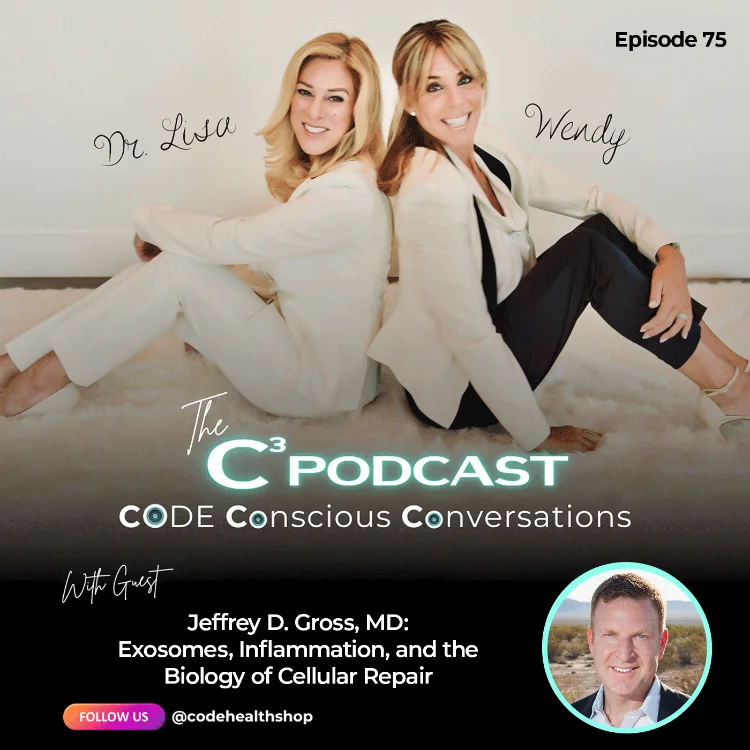
In this episode of C3: CODE Conscious Conversations, we explore these concepts with Jeffrey D. Gross, MD, a board-certified neurosurgeon specializing in regenerative medicine and cellular repair.
We discuss how exosomes function as biological messengers, why inflammation disrupts repair, how pregnancy illustrates regenerative signaling, and how both human and plant exosomes contribute to longevity science.
🎧 Listen to Episode 75: Exosomes, Inflammation, and the Biology of Cellular Repair on Apple Podcasts or Spotify.