For a long time, aging has been treated as something the calendar decides for us. You reach a certain age and expectations quietly shift. Slower energy. Less capacity. More maintenance.
But anyone who has looked around knows this doesn’t hold up. People of the same age can live in completely different bodies. One person feels strong and engaged. Another feels tired, resigned, and disconnected from their own potential.
That contrast matters. It tells us aging isn’t controlled by time alone. It is shaped by how the body receives, interprets, and responds to information. When internal signals reinforce scarcity, threat, or limitation, biology adapts in that direction. When those signals support adaptability and repair, the body responds differently.
The issue isn’t aging itself. It’s how we’ve misunderstood what actually drives it.
Listen to this podcast now at C3 Podcast or join us on Apple Podcasts or Spotify.
Why Aging Is Not Driven by Time Alone
Chronological age measures one thing only: how long someone has been alive. It moves forward at the same speed for everyone and cannot be changed.
What it does not tell us is how the body is functioning.
Chronological Age vs Biological and Psychological Age
Biological age reflects what is happening inside tissues, organs, and systems. It is influenced by inflammation, mitochondrial function, metabolic flexibility, cellular repair, and immune resilience. Unlike chronological age, biological age responds to inputs. It can accelerate, slow down, or stabilize based on the signals the body receives.
Psychological age adds another layer. It reflects mindset, identity, curiosity, and adaptability. This internal state shapes behavior, stress response, and long-term physiological patterns more than most people realize.
When chronological age gets confused with decline, people overlook the two dimensions they can actually influence. Aging is not a single process. It is an interaction between biology, perception, and information.
How Cellular Communication Drives the Aging Process
At its foundation, the body works through communication.
Every cell is constantly receiving signals from internal chemistry, the environment, movement, nutrition, language, emotional states, and perception. Those signals determine whether a cell stays in protection mode or shifts into repair, regeneration, and adaptation.
Chronic stress, inflammation, metabolic overload, and environmental strain distort this communication. When signaling becomes noisy, repair slows. Systems become reactive instead of resilient.
Cells do not respond because something is forced onto the system. They respond when the signal makes sense.
This is where many well-intentioned approaches fall short. Without clear communication, even helpful inputs may not land the way we expect.
Why Belief and Language Influence Biology
Beliefs are often treated as motivational concepts. In practice, they function as biological input.
The words people use to describe aging influence nervous system tone, hormonal signaling, and daily behavior. Repeating phrases like “I’m getting old” or “this is just what happens after 50” reinforces stress patterns and resignation. Over time, those narratives shape physiology.
Stress hormones, inflammatory markers, and immune responses are all sensitive to perception. Language creates context. Context determines response.
Belief does not replace biology. It informs it.
Why More Interventions Don’t Improve Healing
Wellness culture often equates progress with accumulation. More supplements. More protocols. More interventions stacked on top of each other.
Biology doesn’t work that way.
Excessive inputs can create competing signals instead of clarity. When the body is overloaded, it spends energy sorting noise rather than carrying out repair. Progress stalls. Fatigue builds. Frustration sets in.
Across cellular signaling, neurology, and adaptive physiology, research continues to show the same principle. Small, precise inputs often create stronger responses than aggressive approaches. Less becomes more when the signal is relevant.
Healing improves when communication improves.
What Separates Thriving From Decline Later in Life
When you look closely at people who age well, similar patterns show up again and again.
They stay curious. They continue moving. They adapt their habits instead of clinging to an old identity. They see aging as evolution rather than loss.
Those who struggle often absorb limitation narratives early. They outsource responsibility for their health. They chase fixes instead of rebuilding fundamentals. Over time, this erodes agency, confidence, and biological resilience.
Thriving is rarely about doing everything. It’s about aligning inputs, identity, and expectations with how biology actually functions.
Taking Ownership of Long-Term Health and Vitality
Long-term vitality doesn’t come from following protocols blindly or relying solely on authority. It comes from agency.
The most resilient people place themselves at the center of their health decisions. They build support teams. They stay flexible. They listen to feedback from their body and adjust in real time.
Health becomes a relationship rather than a formula.
That shift from outsourcing to ownership often marks the transition from slow decline to renewal.
Aging Through the Lens of Information Medicine
When aging is viewed through the lens of information and communication, the story changes.
The body is not failing. It is responding to the signals it receives.
When those signals are distorted, aging accelerates unnecessarily. When communication becomes clearer, adaptive capacity returns. Biological resilience strengthens not through force, but through precision.
Aging, from this perspective, is not something to fight. It is something to guide.
The Second Half of Life as a Phase of Renewal
The second half of life is often framed as a narrowing of possibility. In reality, it can become a period of refinement.
As unnecessary complexity falls away, clarity increases. Priorities sharpen. Living with intention becomes more accessible. When belief, biology, and behavior align, vitality often follows naturally.
Age does not define capacity. Communication does.
Explore the Full Conversation
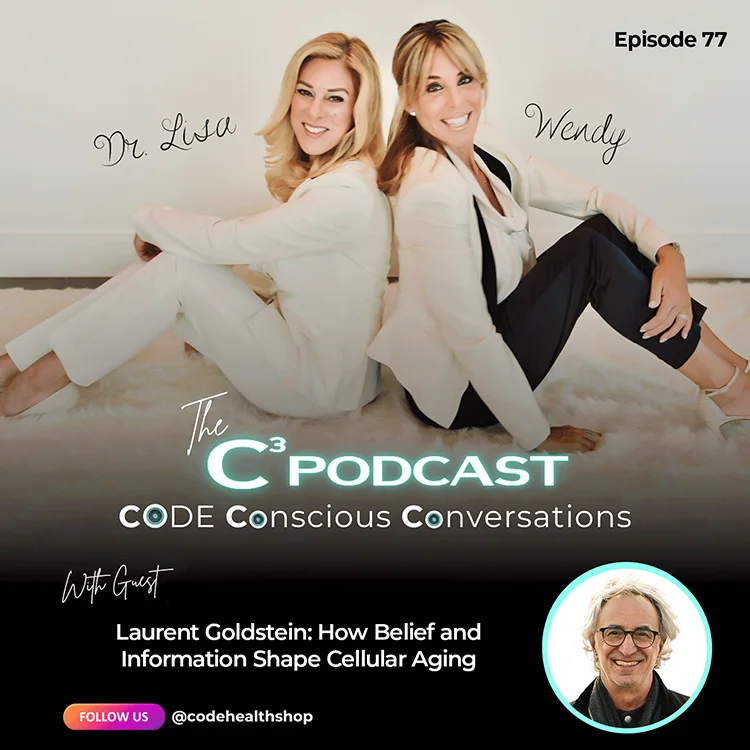
In Episode 77 of C3: CODE Conscious Conversations, we explore these ideas with Laurent Goldstein, filmmaker and creator of Your Second Fifty – Listen to the Lion.
The conversation looks at how belief shapes biology, why chronological age is misleading, how cellular communication influences aging, and what separates those who thrive in the second half of life from those who quietly decline.🎧 Listen to Episode 77: How Belief and Information Shape Cellular Aging on at C3 Podcast or join us on Apple Podcasts or Spotify.